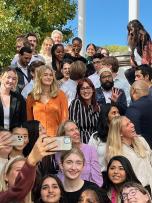
The Pulitzer Center, a journalism and education organization that my husband founded, is now celebrating its 20th anniversary. For many of those years I worked with our university program, providing fellowships to students to report on global issues and mentoring them along the way.
We started with a handful of Fellows, but by 2024, when I left the Pulitzer Center, we had over forty. I like to think the Pulitzer Center left them better equipped to tell stories that matter. Students traveling to India faced unexpected challenges—Anna Schraufnagel (John Hopkins) reported in 110-degree temperature during a heatwave in Bijar, and Taja Mazaj (University of Pennsylvania) spent her first week cooped up in a hostel in Gujarat while a cyclone raged outside.
Our students learned to ask important questions and to build trust, to report with nuance. They learned to seek out stories that have gone untold and to look for nuance and for what may get lost in translation.
I also grew and learned so much along the way. Through their stories I saw landscapes I had never imagined. The shape-changing floating islands in Manipur, India. The blustery saltwater wind in Utqiagvik, Alaska. Fields of ancient olive trees in Puglia, Italy, some decaying, others still green.
I met people who faced horrendous challenges and others who took great risks to help others.
• Muhammad Wasay and Laiba Mubashar (Northwestern University in Qatar) made a film about acid attack survivors—and activists who combat gender-based violence in Pakistan.
• Erin McGoff (American University), winner of the Clio Visualizing History Prize for the Advancement for Women in Film, directed “This Little Land of Mines,” featuring Laotians who are bravely removing unexploded ordnances left behind during the U.S. Secret War.
• Elisa Agosto (Guttman Community College) highlighted Brooklyn’s Workers Justice Project, fighting for the labor rights of cleaners.
• Kateri Donahoe (Boston University) reported on community interventions to stop the practice of female genital cutting in Mali for The Guardian.
Several Fellows reported on the challenges refugees and immigrants face, a subject dear to my heart. Thea Piltzecker and Liz Scherffius (Columbia Journalism School) made a film titled “A Table for All,” featuring refugees who learn English and culinary skills while taking part in Emma’s Torch, a New York classroom café and training program. Ankita Kumar (Medill School of Journalism) directed “Far from Home,” an intimate portrait of an Afghan refugee family in India, that was recently screened at the National Press Club in Washington, D.C.
Imran Mohammad Fazal Hoque (City Colleges of Chicago) was born stateless to Rohingya refugees from Myanmar who could not read or write. Imran made it to the United States at the age of twenty-six after a seven-year journey by way of Bangladesh, Malaysia, and an Australian detention center. It was there that he began to learn English from an Afghan refugee. His stories on the Rohingya diaspora in the Midwest earned him the National Mark of Excellence Award from the Society of Professional Journalists in 2021. He remains an activist for the Rohingya refugee cause and a writer on oppression, loneliness, and freedom.
Looking back on the last 20 years, I take great pride not only in the stories our Campus Consortium students told as Reporting Fellows, but also in all that they went on to do in later years. Among the many alums who stand out are:
Linda Qui (University of Chicago) is a reporter at The New York Times. Praveena Somasundaram (Guilford College) and Kadia Goba (Hunter College) are both at The Washington Post. Olivia Diaz (University of Richmond) is with AP. Catherine Cartier (Davidson College) is now at Reuters. Lawrence Andrea (University of Wisconsin) is a Bangkok editor for Agence-France Presse. Dan Merino (Boston University) is a science editor for The Conversation. Alums have worked as fulltime reporters or editors at NPR, Politico, Missoulian, Fort Worth Star-Telegram, Vox, NBC, CBS, National Geographic, Inside Climate News, USA Today, and Semafor.
Other alums have gone on to study law, medicine, or journalism; they are pursuing careers in public interest law, international affairs and diplomacy, humanitarian aid, and public health. They have worked as journalists in Venezuela, Czechia, and Lebanon. Anton Delgado (Elon University) and Musinguzi Blanshe (Columbia Journalism School) were named Pulitzer Center Rainforest Investigations Fellows, and others have become Pulitzer Center grantees. Our alums include a Truman Scholar, a Marshall Scholar, a New York Times Local Investigations Fellow, three Fulbright Fellows, and three Overseas Press Club Scholars. Alums have also won numerous awards for their documentaries, among them the Student Academy Award, BAFTA Student Film Award, Chicago South Asian Film Festival, and Best Director at DOC LA.
In 2011, Julia Rendleman reported on farmers in Jamaica; she is now a journalism professor at her alma mater, Southern Illinois University at Carbondale. Meghan Dhaliwal, a Boston University student, covered the aftermath of the cholera outbreak in Haiti in 2012. She later worked as an intern and our multimedia coordinator and is now a documentary photographer with work published in The New York Times and The New Yorker.
Our alums as well as our professional journalist grantees have served as advisers, making connections, shepherding the students through their projects, and providing reporting tips and life lessons. Many thanks to them and to all who have supported our Reporting Fellows in so many ways: our Campus partners and the Pulitzer Center staff and interns past and present.
I will treasure forever the relationships I’ve built with Reporting Fellows and our multiple conversations over email, Zoom, What’s App, and in person. I learned (and admired) just how flexible and resilient you are. You knew to go where the story took you. So many of your stories have stayed with me and with all the readers and viewers they touched.